Showing posts with label PULP FICTION. Show all posts

Tuesday, April 9, 2013

'Cause everybody knows, she's a femme fatale

If you read the forward to any novel or short story collection published today, there is a strong chance it is going to read more like a psychiatrist's notes on a patient than a discussion of the fiction you're about to read. Especially if the author is a male author from the Bad Old Days.

You can be assured you're going to be treated to some Freudian wrongheadedness about the author and his mother. If she was in his life, she is the model for every female character he ever sketched (including the IHOP waitress featured in chapter two. Lotta mommy stuff going on there. I mean, c'mon, waffles with two scoops of ice cream? Do I have to draw you a map?). If she wasn't in his life, the "anger towards women" he evidently displays on every page stems from his anger about her absence. Where else would all these "femme fatales" come from?

Listen: until very recently, the vast majority of writers were men. What concerns most men most? Women. Hell, what concerns most readers most? Relations between the sexes. So if most writers were men, and men are concerned with women, and relations between the sexes have a long history of holding readers' interest, it is not that far fetched to think that maybe literary tropes like "femme fatales" have more to do with statistics than a deep seated, structural hatred of women. Plots have to come from somewhere.

Also, in the past fifty years ago many colleges have been reduced to liberal arts softball leagues built around kids who got a -17 SAT math score. This means MUCH bigger liberal arts/social science departments, many more people sitting through the witchcraft taught in those classes, and many more people graduating with useless degrees that train them to do what? Teach liberal arts foolishness to others, naturally. This means many more dunces getting graduate degrees in Liberal Arts Hypnosis meaning many more dissertations meaning many more contrived investigations into the alleged "sexual repression" and related "misogyny" found in every syllable put on paper prior to the Summer of Love.  

Not surprisingly, such an echo chamber has produced multiple generations of indignant dullards whose M.O. is to shout misogyny first and ask questions later. Even twenty years ago, the word misogyny was still fairly obscure. Now you find it in tweets about Matlock.

How did the word misogyny become more overplayed than Led Zeppelin? Statistics. More liberal arts "schooling" means more circulation of words like misogyny means more foolish Freudian analysis of every male author who ever lived. And with liberal arts-contaminated women now dominating the publishing biz, perhaps it isn't shocking that today's book reviews and literary essays take it for granted that if you scratch any male author hard enough you'll find a mommy-hating brute.

Let's look at the assumptions of all this pseudo-analysis, starting with "sexual repression." I--and most other men-- probably wouldn't mind sleeping with at least 1 out of every 20 women I see. But I can't, because that just isn't the way life works; not even in today's sexually free society. Does this fact of life equal sexual repression? After all, my urges are not being expressed as I would like them to be. And I would like to sleep with 1 out of every 1 supermodels I see. Unfortunately, I am only tall enough to come up to mid-calf on most supermodels, so I do not do well with that demographic. Does this automatically mean I'm walking around with Petruchio-like rage against supermodels? Of course not.

Lots of things were different back in the day. Many more women used to die during childbirth, so having a woman die in a novel could just as easily have been attributed to the realities of the day, as opposed to "matricidal urges" or an innate fear of lady parts. 

Imagine if every male reviewer (or student) approached every female author looking for...no, EXPECTING misandry. Imagine if every literary review and college paper about female writing had misandry as its baseline assumption. Well, to begin with, no one would know what that meant, because misandry--hatred of men--is a largely unknown word. How telling...
Fiction has to at least nominally be about something (even in French literature). Usually this requires imperfect characters (women and men). If the characters were perfect, there wouldn't have been any drama or suspense to keep readers' reading:

Meet Suzie. She's a self-assured, free thinking woman with an IQ of 180 and remarkable ability to match or exceed men in every physical activity. She meets Nathaniel. Nathaniel doesn't notice her looks at all, and instead immediately falls in love with her immaculate sense of self. The End.

Not exactly a page-turner. Drama requires flawed characters, and writing a flawed woman doesn't necessarily stem from hatred, yet this assumption is now as common as the cold. 

Another piece of flint off Occam's Razor: Lots of writers are just untalented, so they can only write one dimensional characters. To say that a hack was deliberately out to savage women by writing them crudely is probably overstating his abilities. No need to go spelunking through his personal life to find out why the female characters weren't fleshed out in a piece of hackwork called, "Scotch Egg, English Yolk."

Frankly, there's no need to even read novels anymore. The best fiction can be found in literary criticism.




Sunday, October 14, 2012

H.P. Lovecraft's Early Days in the Afterlife

"From even the greatest of horrors irony is seldom absent."

--H.P. Lovecraft

Edmund Wilson, esteemed literary critic of the first half of the 20th Century, famously did the first serious critical review of horror writer H.P. Lovecraft. Titled “Tales of the Marvellous and the Ridiculous”, Wilson’s essay was published in The New Yorker in 1945 (Lovecraft died in 1937). The piece was scathing*, saying "the only real horror in most of these fictions is the horror of bad taste and bad art." He then went on to reduce Cthulhu, Lovecraft’s most famous monster, to “a giant whispering octopus.”**

Had Wilson been able to put aside his prejudices against pulp writing, he might have noticed that Lovecraft was probably among America’s first consistent and skillful existentialist writers.
But as unflattering as this all was to the great Lovecraft, in many ways Lovecraft was fortunate to have received this flogging. Edmund Wilson was very highly regarded at the time, and this thrashing took place in the The New Yorker of all places. These two facts are quite remarkable when you consider just what an unloved writer Lovecraft had been.
When Lovecraft died in 1937, his works had never made it into bookstores as a collection. Despite publishing the vast majority of his stories in Weird Tales, his home magazine never made any of his tales a cover story. In fact, in October 1937, just seven months after his death, Weird Tales performed a coup; a posthumous publication of Lovecraft’s The Shunned House, its first proper appearance in print. Alongside the story, Weird Tales included this bursting praise:
Howard Phillips Lovecraft died last March, at the height of his career. Though only forty-six years of age, he had built up an international reputation by the artistry and impeccable literary craftsmanship of his weird tales; and he was regarded on both sides of the Atlantic as probably the greatest contemporary master of weird fiction.
Despite calling him “probably the greatest contemporary master of weird fiction,” and despite the commercial potential of playing up this previously unpublished story, THEY STILL DIDN’T MAKE IT THE COVER STORY. Instead, the readers of October 1937 were treated to something called “Tiger Cat”.
To be fair, I have not read “Tiger Cat.” Maybe it would have increased my fear of both tigers and cats. Regardless, I find it shocking that Lovecraft couldn’t even secure a cover when it would have made the most commercial sense. Who doesn’t want to exploit a newly dead guy to increase sales, especially in 1937, with the country still in the Depression???
I cannot entirely blame Wilson, a man accustomed to poring over proper publications, for not approaching Lovecraft seriously when even Lovecraft’s home publication didn’t seem willing to set him apart. And while pulp fans may have nostalgic affection for Weird Tales, sentimentality aside, many of its stories and covers*** were unintentionally hilarious.
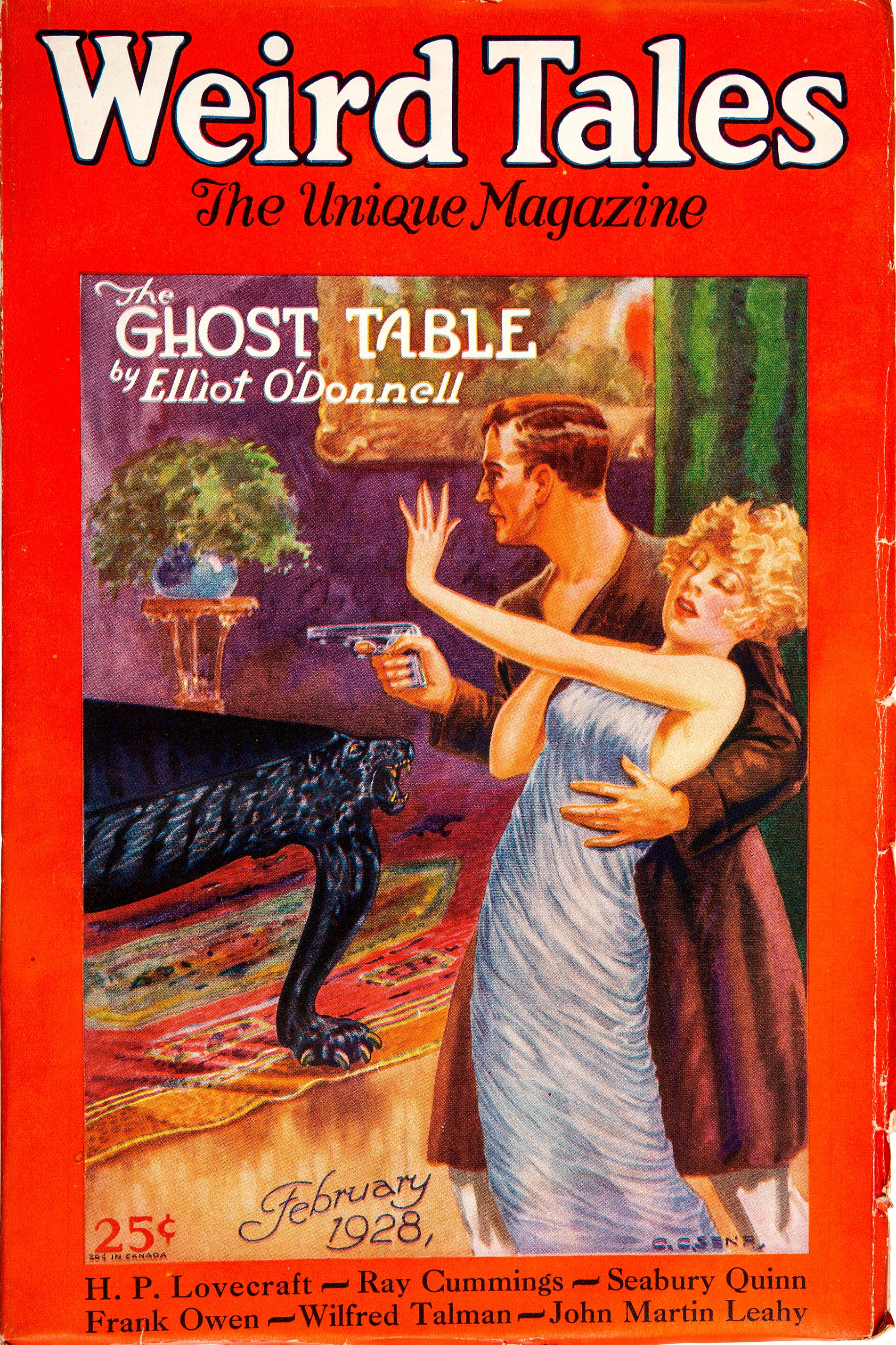
Case in point: I mentioned Wilson’s bashing of Cthulhu. When "The Call of Cthulhu" was first published in 1928, this landmark in horror writing did not make it on the cover of Weird Tales. Instead, readers of 1928 were treated to the horrors of “The Ghost Table”:
 
The Ghost Table? What, does it get surly when you try to dust it? Does it smother people with Pledge?

Given that Weird Tales was Lovecraft's primary forum, maybe it shouldn't be surprising that Lovecraft once suffered from guilt by association. Similar prejudice exists today. In its prime Playboy gave attention to many neglected/soon to be famous literary luminaries. But try bringing that up in your next literary conversation and see how quickly you have to explain you're not a porn freak.
By the time Wilson got around to bashing Lovecraft, a small and eventually famous publisher called Arkham House had begun publishing Lovecraft in book form. Check out the very charming cover of their first Lovecraft collection.  

But even this cover didn't totally break from the pulp tradition; it still featured exposed nipples, which could not have been farther removed from Lovecraft’s output (or personal life). Oh well, nipples have been closing transactions since the first caveman opted for a Paleolithic Slugger rather than wait for last call, so I can hardly knock Arkham House for going with what works.
 
I bet when Edmund Wilson weighed in on Lovecraft, he thought he was putting the subject to rest. I bet he thought his sturdy reputation and the reputation of The New Yorker would be more than enough to halt the rise of the Lovecraft "cult" (his word). It didn't work out that way. Today mighty Cthulhu lives and no one but a few dorks care about Mr. Wilson.

Still, maybe Lovecraft is indebted to Wilson. Maybe the mere fact that a major literary critic stooped to bash Lovecraft helped lift his name from the bowels of the pulp world and into more polite company. Maybe Lovecraft fans should be hailing Wilson's contribution to the astonishing posterity that Lovecraft's work now enjoys. Maybe there really is no such thing as bad publicity. It certainly can't be worse than playing second fiddle to "The Ghost Table".
 
*I don't agree with Wilson's assessment of Lovecraft, but at least the essay is well written and amusing. More importantly, unlike nearly all reviews I read today, IT ACTUALLY PROVIDES YOU WITH A CLEAR IMPRESSION OF LOVECRAFT'S STYLE AND SUBJECTS. Isn't that what reviews are for? Wilson at least cared enough to delve into the particulars of Lovecraft's approach, and he had a point about some of Lovecraft's excesses.

**Lovecraft was in good company. In 1947 Wilson wrote of Kafka: "I find it impossible to take him seriously as a major writer, and have never ceased to be amazed at the number of people who can."

***I have a soft spot for many of these covers, but prolonged exposure to them is worse for the IQ than lead paint, something an aristocrat like Lovecraft would not have endorsed.