Showing posts with label literature. Show all posts
Showing posts with label literature. Show all posts
Friday, November 4, 2016


Friday, June 3, 2016
Monday, April 20, 2015
If you aren't afraid of mimes, you should be
A very short weird tale I wrote - The Discussion of Mimes - has been produced as a podcast over at Pseudopod.org. Hope you enjoy. And tell your friends. And tell your friends to send me money. And tell your friends to put me in their wills.
Friday, January 2, 2015
The Girl Who Probably Despised Dragon Tattoos
Ayn Rand's Atlas Shrugged is easily the most famous libertarian novel of all time, and if you take anti-welfare state/laissez-faire regulation to be conservative viewpoints, you could also call it the most successful "conservative" novel of all time. This despite the fact that it is over 1,000 pages long, is full of l-o-o-o-o-ng philosophical passages, and isn't a staple of school curriculums.
I'm thinking of this because I just turned the last page of The Girl with the Dragon Tattoo, which reads like it was written by Tori Amos in the throes of an Adderall binge (though it certainly isn't a bad read). It has passages that are fairly unapologetic didacticism; all from a left-wing point of view. I'm a pretty avid fiction reader, and I cannot think of many right-wing/libertarian equivalents. Rarely do you encounter any contemporary fiction (or much past fiction, for that matter), particularly anything from a major publisher, that offers any alternative to the Progressive Consensus innate to nearly all editors, book reviewers, and literary professors (though they fancy this consensus to be obscure and rebellious). Maybe Tom Wolfe's Bonfire of the Vanities; not a manifesto by any stretch, but it does at least lampoon some progressive hobby-horses. Maybe some of Robert Heinlein's novels*?
So if you're shopping for a gift for a nephew or granddaughter, and you're a conservative or libertarian leaning person, what exactly do you have to choose from? You have to stretch your brain to make even a short list, and if you're not a major fiction consumer, you could easily be unaware of the existence of writers like Heinlein.
Probably the only libertarian/conservative novel that is consistently on people's tongues is Atlas Shrugged (or Rand's The Fountainhead). Maybe that is part of the explanation for its truly astounding success; it has no competitors.
*Orwell doesn't count; everyone thinks Animal Farm and 1984 are about the people they disagree with.
I'm thinking of this because I just turned the last page of The Girl with the Dragon Tattoo, which reads like it was written by Tori Amos in the throes of an Adderall binge (though it certainly isn't a bad read). It has passages that are fairly unapologetic didacticism; all from a left-wing point of view. I'm a pretty avid fiction reader, and I cannot think of many right-wing/libertarian equivalents. Rarely do you encounter any contemporary fiction (or much past fiction, for that matter), particularly anything from a major publisher, that offers any alternative to the Progressive Consensus innate to nearly all editors, book reviewers, and literary professors (though they fancy this consensus to be obscure and rebellious). Maybe Tom Wolfe's Bonfire of the Vanities; not a manifesto by any stretch, but it does at least lampoon some progressive hobby-horses. Maybe some of Robert Heinlein's novels*?
So if you're shopping for a gift for a nephew or granddaughter, and you're a conservative or libertarian leaning person, what exactly do you have to choose from? You have to stretch your brain to make even a short list, and if you're not a major fiction consumer, you could easily be unaware of the existence of writers like Heinlein.
Probably the only libertarian/conservative novel that is consistently on people's tongues is Atlas Shrugged (or Rand's The Fountainhead). Maybe that is part of the explanation for its truly astounding success; it has no competitors.
*Orwell doesn't count; everyone thinks Animal Farm and 1984 are about the people they disagree with.
Saturday, August 23, 2014
The Organic Growth of Cthulhu
"The Raven" is unquestionably one of the most well-known slices of the macabre. Every kid in America gets a direct order from a teacher to read Edgar Allan Poe's "The Raven". References to the poem pop up frequently; TV, Halloween paraphernalia - and I would guess the majority of Americans know the poem well enough to recognize "Nevermore."
I write all this because I recently received a Cthulhu cookie-cutter as a gift (the benign, cute Cthulhu), and could only marvel at the improbable stature Lovecraft's creations have reached; all without official sanction from the education system. Except for specialized college courses, Lovecraft does not appear in classroom study.
Hollywood hasn't helped. There have been no blockbuster films* based on Lovecraft's works. Probably the most famous (and they weren't that famous) Lovecraft adaptations for television were on the '70s show Night Gallery, remembered mainly because Rod Serling hosted it. Meanwhile Edgar Allan Poe's name has been a selling point on several movies (including many high profile ones) since the beginning of film.
Yet Lovecraft's creations, Cthulhu in particular, seem not only to enjoy sprawling popularity, but also to inspire an unutterable number of homages.
Type "Cthulhu" into Google Images. In addition to many creepy and varied portraits of the monster itself, you will find a nameless array of clever parodies:
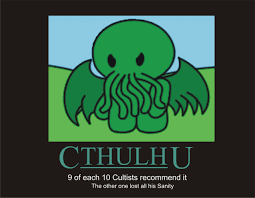
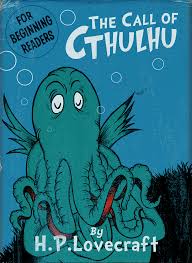
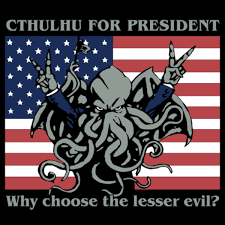
Keep in mind, this is without typing "Cthulhu funny" or "Cthulhu parody."
Typing "R'Lyeh" - the non-euclidean city from whence Cthulhu came - generates witty results like this:

Punch "non-euclidean" into Google Images; Lovecraft is the fourth entry. Even if you type "non-euclidean geometry buildings," you get at least as many Lovecraft references as you do serious ones.
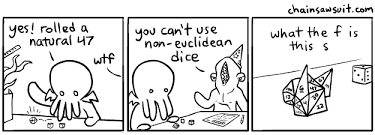
The miscellany of Cthulhu merchandise that can be found online is enough to make someone flee from the light into the peace and safety of a new dark age. Try it for yourself; most any product you can (un)name has an effulgent variety of Cthulhu incarnations.

Typing "The Raven" into Google Images doesn't begin to produce comparable results. Other prominent fantasy staples like Lord of the Rings also don't appear to inspire a following quite as eclectic as Cthulhu's. And the ubiquitousness of Cthulhu was mostly achieved outside the standard avenues of pop culture immortalization.
All this humor linked to a man who was a bit of a stiff. All this affection for a tenebrous fellow who confessed to fellow writers:
Much like the writers who codified, continued, and spotlighted the Cthulhu Mythos (spotlighting Lovecraft himself along the way), thousands of others continue using H.P.'s motifs as inspiration. What had sunk has risen, and what has risen will continue rising.
*Ironically, Re-Animator, based on a tale Lovecraft probably composed as semi-parody, is so far the most commercially successful Lovecraft adaptation.
Follow my unmentionable tweets: https://twitter.com/greatMikePayne
I write all this because I recently received a Cthulhu cookie-cutter as a gift (the benign, cute Cthulhu), and could only marvel at the improbable stature Lovecraft's creations have reached; all without official sanction from the education system. Except for specialized college courses, Lovecraft does not appear in classroom study.
Hollywood hasn't helped. There have been no blockbuster films* based on Lovecraft's works. Probably the most famous (and they weren't that famous) Lovecraft adaptations for television were on the '70s show Night Gallery, remembered mainly because Rod Serling hosted it. Meanwhile Edgar Allan Poe's name has been a selling point on several movies (including many high profile ones) since the beginning of film.
Yet Lovecraft's creations, Cthulhu in particular, seem not only to enjoy sprawling popularity, but also to inspire an unutterable number of homages.
Type "Cthulhu" into Google Images. In addition to many creepy and varied portraits of the monster itself, you will find a nameless array of clever parodies:
Keep in mind, this is without typing "Cthulhu funny" or "Cthulhu parody."
Typing "R'Lyeh" - the non-euclidean city from whence Cthulhu came - generates witty results like this:
Punch "non-euclidean" into Google Images; Lovecraft is the fourth entry. Even if you type "non-euclidean geometry buildings," you get at least as many Lovecraft references as you do serious ones.
The miscellany of Cthulhu merchandise that can be found online is enough to make someone flee from the light into the peace and safety of a new dark age. Try it for yourself; most any product you can (un)name has an effulgent variety of Cthulhu incarnations.
Typing "The Raven" into Google Images doesn't begin to produce comparable results. Other prominent fantasy staples like Lord of the Rings also don't appear to inspire a following quite as eclectic as Cthulhu's. And the ubiquitousness of Cthulhu was mostly achieved outside the standard avenues of pop culture immortalization.
All this humor linked to a man who was a bit of a stiff. All this affection for a tenebrous fellow who confessed to fellow writers:
Of course, I am unfamiliar with amatory phenomena save
through cursory reading.
Much like the writers who codified, continued, and spotlighted the Cthulhu Mythos (spotlighting Lovecraft himself along the way), thousands of others continue using H.P.'s motifs as inspiration. What had sunk has risen, and what has risen will continue rising.
*Ironically, Re-Animator, based on a tale Lovecraft probably composed as semi-parody, is so far the most commercially successful Lovecraft adaptation.
Follow my unmentionable tweets: https://twitter.com/greatMikePayne
Saturday, January 18, 2014
Why most book reviewers are even dumber than sports radio callers
When hack reviewers aren't minimizing "genre" fiction (and genre film, for that matter), as "page-turners" or "popular fiction," they are reducing its contents to snarky captions; especially when a "literary" reviewer stoops to review it. A typical (and typically grating) example comes to us from professional hater Michiko Kakutani. Her review in the New York Times (the paper of record, if by record you mean as obsolete as vinyl) of Scott Smith's horror novel The Ruins carries this precious title: "A Mexican Vacation, Interrupted by Killer Plants".
I'm sure Ms. Kakutani was very proud of herself for tweeing off on Mr. Smith's work (strange she doesn’t apply her sublime talent to creating a stack of her own novels). I wonder if she and the rest of the sneering mannequin community realize you can mock classic fiction in exactly the same way:
Hamlet: Family Feud involving ghosts and Scandinavians.
Moby-Dick: Sailor who doesn't suffer fools gladly chases large whale.
Pride and Prejudice: Upper class chick hates bad boy before liking him.
Everything in fiction sounds silly if you nanosize it. Metaphors and allegories become full blown laugh riots if you cut them to the bone. Hemingway’s The Old Man and the Sea (which helped him win the Nobel) becomes a tale of a big one that got away; one so big it is Christ-like.
If your friend told you his nightcrawlers helped him catch a dead savior, chances are you’d be choking on laughter rather than tears. But in the context of Hemingway’s novel, this normally tedious imagery becomes extremely powerful.
This is why I (and the rest of mankind) give every Kakutani review the same headline: "Hack reviewer writes hack reviews valued only by other hack reviewers."
I'm sure Ms. Kakutani was very proud of herself for tweeing off on Mr. Smith's work (strange she doesn’t apply her sublime talent to creating a stack of her own novels). I wonder if she and the rest of the sneering mannequin community realize you can mock classic fiction in exactly the same way:
Hamlet: Family Feud involving ghosts and Scandinavians.
Moby-Dick: Sailor who doesn't suffer fools gladly chases large whale.
Pride and Prejudice: Upper class chick hates bad boy before liking him.
Everything in fiction sounds silly if you nanosize it. Metaphors and allegories become full blown laugh riots if you cut them to the bone. Hemingway’s The Old Man and the Sea (which helped him win the Nobel) becomes a tale of a big one that got away; one so big it is Christ-like.
If your friend told you his nightcrawlers helped him catch a dead savior, chances are you’d be choking on laughter rather than tears. But in the context of Hemingway’s novel, this normally tedious imagery becomes extremely powerful.
This is why I (and the rest of mankind) give every Kakutani review the same headline: "Hack reviewer writes hack reviews valued only by other hack reviewers."
Thursday, January 16, 2014
Micro Horror from a Micro Person
You already know I'm a comedic blowhard. You may not know I'm also a fiction writing blowhard. I have a flash fiction (about 200 words) horror story up on microhorror.com.
Saturday, September 14, 2013
An author shouldn't always want to be quotable
***Spoiler for Chinatown appears below***
A man is the sum of his misfortunes. One day you'd think misfortune would get tired, but then time is your misfortune.
Sin and love and fear are just sounds that people who never sinned nor loved nor feared have for what they never had and cannot have until they forget the words.
Those are two quotes from the novels of the oft quoted William Faulkner. I could list juicy tidbits from the man from Mississippi all day. I could not however spend a day reading the novels themselves. They are tedious, partly because they are crammed with quotable moments.
Often, the novels with the best quotes aren't the best novels, because the author forces in lots of great quotes at the expense of the story. It is even more grating when these perfectly formed lyricisms and insights are presented as dialogue. No authentic human sits around unleashing proverbs that outdo the King James Bible, yet authors create characters like this all the time. I get it, these writers want to be quoted 100 years after they're dead, so they inject mini-essays into their novels whether they belong or not, ignoring that essays and novels are different things.
The Picture of Dorian Gray is full of amazing quotes, most of them uttered by the character Henry Wotton. The first half is largely a showcase for Wotton's witticisms and worldview, and this hurts the novel. Apart from the fact that even the world's greatest conversationalist isn't a gushing fount of future Bartlett's familiar quotations, having a character essay rather than speak to show how he influences another character (Dorian) is a bit too on-the-nose. The novel is still entertaining, simply because Wilde was the greatest inventor of quips to write in English.
I know it isn't a novel, but the film Chinatown is an example of creating cumulative effect without dozens of florid, standalone quotes. The last line: "Forget it Jake, it's Chinatown" isn't so impactful by itself. But it is the perfect culmination of the film's story and tone, and is devastating thanks to the film's cumulative effect; its feel. If Jake Gittes spent the whole time unleashing Socratic monologues, neither the last line nor the film would have worked as well.
Some writers who knew about cumulative effect: Camus, Graham Greene, Orwell, Kafka, Flannery O'Connor. Orwell could be didactic, but his work is referenced - Newspeak, doublethink, memory hole, Thought Police - far more often than it is quoted. And when his novels are quoted, it is often explicit political slogans from them - Some animals are more equal than others, WAR IS PEACE -; not quips clumsily inserted to remind the reader what the book is about. Thanks to the cumulative effect and feel of Animal Farm, you can simply describe something as being like Animal Farm, and everyone knows what you mean. Not so true of the quote-filled The Sound and the Fury.
The better novels are the ones that achieve a cumulative effect, and because their insights and tones aren't explicitly stated, snipped passages from them don't stand out the way the great quotes from the lesser novels do. See, I just spelled everything out rather than let this rant have a cumulative effect!
Watch me outquip Oscar Wilde: https://twitter.com/greatMikePayne
A man is the sum of his misfortunes. One day you'd think misfortune would get tired, but then time is your misfortune.
Sin and love and fear are just sounds that people who never sinned nor loved nor feared have for what they never had and cannot have until they forget the words.
Those are two quotes from the novels of the oft quoted William Faulkner. I could list juicy tidbits from the man from Mississippi all day. I could not however spend a day reading the novels themselves. They are tedious, partly because they are crammed with quotable moments.
Often, the novels with the best quotes aren't the best novels, because the author forces in lots of great quotes at the expense of the story. It is even more grating when these perfectly formed lyricisms and insights are presented as dialogue. No authentic human sits around unleashing proverbs that outdo the King James Bible, yet authors create characters like this all the time. I get it, these writers want to be quoted 100 years after they're dead, so they inject mini-essays into their novels whether they belong or not, ignoring that essays and novels are different things.
The Picture of Dorian Gray is full of amazing quotes, most of them uttered by the character Henry Wotton. The first half is largely a showcase for Wotton's witticisms and worldview, and this hurts the novel. Apart from the fact that even the world's greatest conversationalist isn't a gushing fount of future Bartlett's familiar quotations, having a character essay rather than speak to show how he influences another character (Dorian) is a bit too on-the-nose. The novel is still entertaining, simply because Wilde was the greatest inventor of quips to write in English.
I know it isn't a novel, but the film Chinatown is an example of creating cumulative effect without dozens of florid, standalone quotes. The last line: "Forget it Jake, it's Chinatown" isn't so impactful by itself. But it is the perfect culmination of the film's story and tone, and is devastating thanks to the film's cumulative effect; its feel. If Jake Gittes spent the whole time unleashing Socratic monologues, neither the last line nor the film would have worked as well.
Some writers who knew about cumulative effect: Camus, Graham Greene, Orwell, Kafka, Flannery O'Connor. Orwell could be didactic, but his work is referenced - Newspeak, doublethink, memory hole, Thought Police - far more often than it is quoted. And when his novels are quoted, it is often explicit political slogans from them - Some animals are more equal than others, WAR IS PEACE -; not quips clumsily inserted to remind the reader what the book is about. Thanks to the cumulative effect and feel of Animal Farm, you can simply describe something as being like Animal Farm, and everyone knows what you mean. Not so true of the quote-filled The Sound and the Fury.
The better novels are the ones that achieve a cumulative effect, and because their insights and tones aren't explicitly stated, snipped passages from them don't stand out the way the great quotes from the lesser novels do. See, I just spelled everything out rather than let this rant have a cumulative effect!
Watch me outquip Oscar Wilde: https://twitter.com/greatMikePayne
Tuesday, September 3, 2013
15 Famed Literature Titles Taken from Other Artists
Over the years I have heard complaints about contemporary art/entertainment being lazily drenched with references to previous works of art. I have heard this complaint come from my own mouth. The formula for book titles now is to take a famous title and change one word in it; usually in an ironic way. So much TV comedy relies on parodies of famous film and TV references. Maybe this started with the archival/repetitive nature of TV - seeing the same episodes, commercials, and movies rising again and again from the TV Netherworld - and accelerated with the resurrection of everything via the Internet. You're headbutted with the same clips so many times your mind can't help but think of a reference before conjuring something more original.
It is a tendency that is often odious, but we should remember how many classic works of art used references unironically. Think of all the book titles taken from Shakespeare:
Brave New WorldIt is a tendency that is often odious, but we should remember how many classic works of art used references unironically. Think of all the book titles taken from Shakespeare:
Pale Fire
The Sound and the Fury
Or the Bible:
House of Mirth
The Sun Also Rises
The Violent Bear It Away
The Bible isn't the only religious text used for inspiration:
The Razor's Edge: The Katha Upanishad
Poetry has also given us plenty of fodder for book titles:
Tender Is the Night: Keats
Look Homeward, Angel: Milton
Things Fall Apart: Yeats
And some poems reference other poems:
I Know Why the Caged Bird Sings: Dunbar
Some more random sources of inspiration:
The Grapes of Wrath: "The Battle Hymn of the Republic"
All the King's Men: Humpty Dumpty
Shakespeare got his lines from my Twitter feed: https://twitter.com/greatMikePayne
Monday, June 10, 2013
Did I tell you my 50 Shades of Grey story?
I had not heard of 50 Shades of Grey until an old woman in my building started explaining it to me. I was up on the roof deck, minding my own business, and I guess she wanted me to know she was hip, so she randomly launched into a rant about it. As you can imagine, this was not comfortable for me, or for the dust mites on my crawling skin. I figured she was senile and just flashing back to how they had sex during the Depression. When I looked it up and saw that it was a real book AND a bestselling one at that, I wondered if I might be senile. Ignorance is (was) bliss.
Monday, May 27, 2013
Economic Value: Books vs. Music
Compared to other forms of entertainment, the pleasurable effects of music are less likely to wear off. People turn to a favorite album far more often than a favorite short story or favorite film. All entertainment experiences diminishing returns, but on balance, the returns from music are more consistent and stable than its competitors.
A telling example of this: You read a book in a bookstore so you don't have to buy it. You listen to an album in a record store (when they existed) to see if you want to buy it.
An average album doesn't "end" for you. The greatest book does.
A telling example of this: You read a book in a bookstore so you don't have to buy it. You listen to an album in a record store (when they existed) to see if you want to buy it.
An average album doesn't "end" for you. The greatest book does.
Friday, May 24, 2013
"Important" Writers You can Safely Avoid
There is too damn much to read in this world, and not enough cocaine to make all of it interesting. What's worse, there is constant pressure from sadistic teachers and zombified book reviewers to choose thrill-free fiction. Someday you're going to die, and the time you spend trying to figure out why Slaughterhouse-Five is still in print is time you never get back. Think about that. Seriously.
Should you decide to read some literary fiction you need a list of BIG FORMIDABLE AUTHORS to leave OFF your list. For starters:
Joseph Conrad - Great premises undone by tin-eared writing. Hilariously, Joseph is considered a great stylist. I guest Conrad could be called a stylist, in the same way a quadruple amputee tossed on an ice rink could be called a figure skater.
William Burroughs* - If no one knew his biography, his writing would be rightly discarded. Take away his association with the Beat Movement (every Beat writer was horrid), the high profile censorship of Naked Lunch (the only time I've sided with a prosecutor), and the glamor of being a heroin addict (living as a constipated vegetable is the bee's knees), and you're left with a curmudgeon who lacked the ability to make his grouchiness engaging. It doesn't surprise me he killed his wife in a failed William Tell act. He had a knack for missing the mark.
John Updike - No one actually enjoys Updike's writing, so I'll save you the trouble of joining the others in pretending to like him.
J.D. Salinger - In this case I am using the word writer very loosely.
Samuel Beckett - Oh, those Irish existentialists with French tongues! What will they do next? Beckett seemed to believe existence is a painful mistake, and if you spend any time reading him you will find yourself agreeing.
Jorge Luis Borges - Spoiler alert: all of this stories end in boredom.
Joseph Heller - Ever imagined what it would be like if an open-mic comedian wrote an anti-war novel? Now you don't have to. Catch-22, a 400-page root canal, features a character called General Scheisskopf. Get it? Scheiss-kopf. That pain in your ribs? That's Heller's heavy-handed elbow smashing through your ribs with the world's clumsiest nudge. I'm sure giving characters names like Scheisskopf was extremely edgy back in 407 B.C., but here in A.D. land, we need a little more.
Truman Capote - His legacy is a series of commas occasionally interrupted by words.
Mark Twain - Let me guess: You tried reading him and then felt bad for not seeing what all the fuss was about? It's not your fault. You were probably corralled in Twain's direction by professors and critics who know nothing about wit, timing, or even sentence structure. If you like funny writers who are funny, consider Oscar Wilde, Ring Lardner, Evelyn Waugh, Raymond Chandler.
John Cheevers - Railing against the suburbs through the works of people like Cheevers is what suburbanites do to convince themselves they haven't bought into suburbia. And those suburbs sure are heavy, huh? Yes, living with a deck and porch are among Man's great trials. Surprising Sophocles never tackled the pathos of having a lawn.
Sylvia Plath - Irony of ironies: this icon to feminists died in an oven. That has nothing to do with her leaden writing, I just needed a pick-me-up after remembering that time I read The Bell Jar.
*For a treatment of similar themes, complete with entertainment value, try J.G. Ballard; especially his early short stories.
Should you decide to read some literary fiction you need a list of BIG FORMIDABLE AUTHORS to leave OFF your list. For starters:
Joseph Conrad - Great premises undone by tin-eared writing. Hilariously, Joseph is considered a great stylist. I guest Conrad could be called a stylist, in the same way a quadruple amputee tossed on an ice rink could be called a figure skater.
William Burroughs* - If no one knew his biography, his writing would be rightly discarded. Take away his association with the Beat Movement (every Beat writer was horrid), the high profile censorship of Naked Lunch (the only time I've sided with a prosecutor), and the glamor of being a heroin addict (living as a constipated vegetable is the bee's knees), and you're left with a curmudgeon who lacked the ability to make his grouchiness engaging. It doesn't surprise me he killed his wife in a failed William Tell act. He had a knack for missing the mark.
John Updike - No one actually enjoys Updike's writing, so I'll save you the trouble of joining the others in pretending to like him.
J.D. Salinger - In this case I am using the word writer very loosely.
Samuel Beckett - Oh, those Irish existentialists with French tongues! What will they do next? Beckett seemed to believe existence is a painful mistake, and if you spend any time reading him you will find yourself agreeing.
Jorge Luis Borges - Spoiler alert: all of this stories end in boredom.
Joseph Heller - Ever imagined what it would be like if an open-mic comedian wrote an anti-war novel? Now you don't have to. Catch-22, a 400-page root canal, features a character called General Scheisskopf. Get it? Scheiss-kopf. That pain in your ribs? That's Heller's heavy-handed elbow smashing through your ribs with the world's clumsiest nudge. I'm sure giving characters names like Scheisskopf was extremely edgy back in 407 B.C., but here in A.D. land, we need a little more.
Truman Capote - His legacy is a series of commas occasionally interrupted by words.
Mark Twain - Let me guess: You tried reading him and then felt bad for not seeing what all the fuss was about? It's not your fault. You were probably corralled in Twain's direction by professors and critics who know nothing about wit, timing, or even sentence structure. If you like funny writers who are funny, consider Oscar Wilde, Ring Lardner, Evelyn Waugh, Raymond Chandler.
John Cheevers - Railing against the suburbs through the works of people like Cheevers is what suburbanites do to convince themselves they haven't bought into suburbia. And those suburbs sure are heavy, huh? Yes, living with a deck and porch are among Man's great trials. Surprising Sophocles never tackled the pathos of having a lawn.
Sylvia Plath - Irony of ironies: this icon to feminists died in an oven. That has nothing to do with her leaden writing, I just needed a pick-me-up after remembering that time I read The Bell Jar.
*For a treatment of similar themes, complete with entertainment value, try J.G. Ballard; especially his early short stories.
Tuesday, April 9, 2013
'Cause everybody knows, she's a femme fatale
If you read the forward to any novel or short story collection published today, there is a strong chance it is going to read more like a psychiatrist's notes on a patient than a discussion of the fiction you're about to read. Especially if the author is a male author from the Bad Old Days.
You can be assured you're going to be treated to some Freudian wrongheadedness about the author and his mother. If she was in his life, she is the model for every female character he ever sketched (including the IHOP waitress featured in chapter two. Lotta mommy stuff going on there. I mean, c'mon, waffles with two scoops of ice cream? Do I have to draw you a map?). If she wasn't in his life, the "anger towards women" he evidently displays on every page stems from his anger about her absence. Where else would all these "femme fatales" come from?
Listen: until very recently, the vast majority of writers were men. What concerns most men most? Women. Hell, what concerns most readers most? Relations between the sexes. So if most writers were men, and men are concerned with women, and relations between the sexes have a long history of holding readers' interest, it is not that far fetched to think that maybe literary tropes like "femme fatales" have more to do with statistics than a deep seated, structural hatred of women. Plots have to come from somewhere.
Also, in the past fifty years ago many colleges have been reduced to liberal arts softball leagues built around kids who got a -17 SAT math score. This means MUCH bigger liberal arts/social science departments, many more people sitting through the witchcraft taught in those classes, and many more people graduating with useless degrees that train them to do what? Teach liberal arts foolishness to others, naturally. This means many more dunces getting graduate degrees in Liberal Arts Hypnosis meaning many more dissertations meaning many more contrived investigations into the alleged "sexual repression" and related "misogyny" found in every syllable put on paper prior to the Summer of Love.
Not surprisingly, such an echo chamber has produced multiple generations of indignant dullards whose M.O. is to shout misogyny first and ask questions later. Even twenty years ago, the word misogyny was still fairly obscure. Now you find it in tweets about Matlock.
How did the word misogyny become more overplayed than Led Zeppelin? Statistics. More liberal arts "schooling" means more circulation of words like misogyny means more foolish Freudian analysis of every male author who ever lived. And with liberal arts-contaminated women now dominating the publishing biz, perhaps it isn't shocking that today's book reviews and literary essays take it for granted that if you scratch any male author hard enough you'll find a mommy-hating brute.
Let's look at the assumptions of all this pseudo-analysis, starting with "sexual repression." I--and most other men-- probably wouldn't mind sleeping with at least 1 out of every 20 women I see. But I can't, because that just isn't the way life works; not even in today's sexually free society. Does this fact of life equal sexual repression? After all, my urges are not being expressed as I would like them to be. And I would like to sleep with 1 out of every 1 supermodels I see. Unfortunately, I am only tall enough to come up to mid-calf on most supermodels, so I do not do well with that demographic. Does this automatically mean I'm walking around with Petruchio-like rage against supermodels? Of course not.
Lots of things were different back in the day. Many more women used to die during childbirth, so having a woman die in a novel could just as easily have been attributed to the realities of the day, as opposed to "matricidal urges" or an innate fear of lady parts.
Imagine if every male reviewer (or student) approached every female author looking for...no, EXPECTING misandry. Imagine if every literary review and college paper about female writing had misandry as its baseline assumption. Well, to begin with, no one would know what that meant, because misandry--hatred of men--is a largely unknown word. How telling...
Fiction has to at least nominally be about something (even in French literature). Usually this requires imperfect characters (women and men). If the characters were perfect, there wouldn't have been any drama or suspense to keep readers' reading:
Meet Suzie. She's a self-assured, free thinking woman with an IQ of 180 and remarkable ability to match or exceed men in every physical activity. She meets Nathaniel. Nathaniel doesn't notice her looks at all, and instead immediately falls in love with her immaculate sense of self. The End.
Not exactly a page-turner. Drama requires flawed characters, and writing a flawed woman doesn't necessarily stem from hatred, yet this assumption is now as common as the cold.
Another piece of flint off Occam's Razor: Lots of writers are just untalented, so they can only write one dimensional characters. To say that a hack was deliberately out to savage women by writing them crudely is probably overstating his abilities. No need to go spelunking through his personal life to find out why the female characters weren't fleshed out in a piece of hackwork called, "Scotch Egg, English Yolk."
Frankly, there's no need to even read novels anymore. The best fiction can be found in literary criticism.
You can be assured you're going to be treated to some Freudian wrongheadedness about the author and his mother. If she was in his life, she is the model for every female character he ever sketched (including the IHOP waitress featured in chapter two. Lotta mommy stuff going on there. I mean, c'mon, waffles with two scoops of ice cream? Do I have to draw you a map?). If she wasn't in his life, the "anger towards women" he evidently displays on every page stems from his anger about her absence. Where else would all these "femme fatales" come from?
Listen: until very recently, the vast majority of writers were men. What concerns most men most? Women. Hell, what concerns most readers most? Relations between the sexes. So if most writers were men, and men are concerned with women, and relations between the sexes have a long history of holding readers' interest, it is not that far fetched to think that maybe literary tropes like "femme fatales" have more to do with statistics than a deep seated, structural hatred of women. Plots have to come from somewhere.
Also, in the past fifty years ago many colleges have been reduced to liberal arts softball leagues built around kids who got a -17 SAT math score. This means MUCH bigger liberal arts/social science departments, many more people sitting through the witchcraft taught in those classes, and many more people graduating with useless degrees that train them to do what? Teach liberal arts foolishness to others, naturally. This means many more dunces getting graduate degrees in Liberal Arts Hypnosis meaning many more dissertations meaning many more contrived investigations into the alleged "sexual repression" and related "misogyny" found in every syllable put on paper prior to the Summer of Love.
Not surprisingly, such an echo chamber has produced multiple generations of indignant dullards whose M.O. is to shout misogyny first and ask questions later. Even twenty years ago, the word misogyny was still fairly obscure. Now you find it in tweets about Matlock.
How did the word misogyny become more overplayed than Led Zeppelin? Statistics. More liberal arts "schooling" means more circulation of words like misogyny means more foolish Freudian analysis of every male author who ever lived. And with liberal arts-contaminated women now dominating the publishing biz, perhaps it isn't shocking that today's book reviews and literary essays take it for granted that if you scratch any male author hard enough you'll find a mommy-hating brute.
Let's look at the assumptions of all this pseudo-analysis, starting with "sexual repression." I--and most other men-- probably wouldn't mind sleeping with at least 1 out of every 20 women I see. But I can't, because that just isn't the way life works; not even in today's sexually free society. Does this fact of life equal sexual repression? After all, my urges are not being expressed as I would like them to be. And I would like to sleep with 1 out of every 1 supermodels I see. Unfortunately, I am only tall enough to come up to mid-calf on most supermodels, so I do not do well with that demographic. Does this automatically mean I'm walking around with Petruchio-like rage against supermodels? Of course not.
Lots of things were different back in the day. Many more women used to die during childbirth, so having a woman die in a novel could just as easily have been attributed to the realities of the day, as opposed to "matricidal urges" or an innate fear of lady parts.
Imagine if every male reviewer (or student) approached every female author looking for...no, EXPECTING misandry. Imagine if every literary review and college paper about female writing had misandry as its baseline assumption. Well, to begin with, no one would know what that meant, because misandry--hatred of men--is a largely unknown word. How telling...
Meet Suzie. She's a self-assured, free thinking woman with an IQ of 180 and remarkable ability to match or exceed men in every physical activity. She meets Nathaniel. Nathaniel doesn't notice her looks at all, and instead immediately falls in love with her immaculate sense of self. The End.
Not exactly a page-turner. Drama requires flawed characters, and writing a flawed woman doesn't necessarily stem from hatred, yet this assumption is now as common as the cold.
Another piece of flint off Occam's Razor: Lots of writers are just untalented, so they can only write one dimensional characters. To say that a hack was deliberately out to savage women by writing them crudely is probably overstating his abilities. No need to go spelunking through his personal life to find out why the female characters weren't fleshed out in a piece of hackwork called, "Scotch Egg, English Yolk."
Frankly, there's no need to even read novels anymore. The best fiction can be found in literary criticism.
Saturday, October 20, 2012
The only horror tales you need to read
Robert Aickman, the third best horror writer of all time,
once said: "There are only about thirty or forty first-class ghost stories
in the whole of western literature." If it weren’t for Aickman’s contributions, forty would probably
be on the high side.
There are many reasons why a memorable horror story is so tricky to pull off, but right now I have no interest in mining my remarkable brain for the answers.
“Oh, Whistle, and I’ll Come to You, My Lad”
Casting the Runes
The People of the Pit by Abraham Merritt
There are many reasons why a memorable horror story is so tricky to pull off, but right now I have no interest in mining my remarkable brain for the answers.
Halloween is almost here, and it comes but once a year, so here is a nearly complete list of the only horror tales you
need to bother with (some are novellas/novelettes, so I am bending the rules a
bit). I am going to leave out Poe and Stevenson because they are taught
in school, so people get plenty of exposure to them. I’m trying to highlight
writers that non-horror fans might not otherwise encounter.
Lovecraft
Lovecraft
The Call of Cthluhu
The Music of Erich Zann
The Outsider
The Shadow Over Innsmouth
The Colour Out of Space
The Music of Erich Zann
The Outsider
The Shadow Over Innsmouth
The Colour Out of Space
Robert Aickman
Ringing the Changes
The Hospice
The Cicerones
Meeting Mr. Millar
Your Tiny Hand is Frozen
Thomas LigottiThe Hospice
The Cicerones
Meeting Mr. Millar
Your Tiny Hand is Frozen
My Work Is Not Yet Done
Purity
Our Temporary Supervisor
Purity
Our Temporary Supervisor
Algernon Blackwood
The Willows (Lovecraft called this the finest weird tale ever, and I can’t disagree).
The Wendigo
M.R. JamesThe Willows (Lovecraft called this the finest weird tale ever, and I can’t disagree).
The Wendigo
“Oh, Whistle, and I’ll Come to You, My Lad”
Casting the Runes
Mary Elisabeth Counselman
The Black Stone Statue
The Three Marked Pennies
Metamorphosis by Kafka (Kafka is obviously taught in school, but this is a great weird tale that is often soiled by shaky literary analysis, thus robbing virgin readers of potential enjoyment).
Mimic by Donald Wolheim
Night Wire by HF Arnold
Metamorphosis by Kafka (Kafka is obviously taught in school, but this is a great weird tale that is often soiled by shaky literary analysis, thus robbing virgin readers of potential enjoyment).
Mimic by Donald Wolheim
Night Wire by HF Arnold
Nackles by Curt Clark (AKA Donald Westlake)
It's a Good Life by Jerome BixbyThe People of the Pit by Abraham Merritt
The Canal by Everil Worrell
The Voice of the Beach by Ramsey Campbell
The Voice of the Beach by Ramsey Campbell
N by Stephen King.
Sunday, October 14, 2012
H.P. Lovecraft's Early Days in the Afterlife
"From even the greatest of horrors irony is seldom absent."
--H.P. Lovecraft
Edmund Wilson, esteemed literary critic of the first half of the 20th Century, famously did the first serious critical review of horror writer H.P. Lovecraft. Titled “Tales of the Marvellous and the Ridiculous”, Wilson’s essay was published in The New Yorker in 1945 (Lovecraft died in 1937). The piece was scathing*, saying "the only real horror in most of these fictions is the horror of bad taste and bad art." He then went on to reduce Cthulhu, Lovecraft’s most famous monster, to “a giant whispering octopus.”**

*I don't agree with Wilson's assessment of Lovecraft, but at least the essay is well written and amusing. More importantly, unlike nearly all reviews I read today, IT ACTUALLY PROVIDES YOU WITH A CLEAR IMPRESSION OF LOVECRAFT'S STYLE AND SUBJECTS. Isn't that what reviews are for? Wilson at least cared enough to delve into the particulars of Lovecraft's approach, and he had a point about some of Lovecraft's excesses.
**Lovecraft was in good company. In 1947 Wilson wrote of Kafka: "I find it impossible to take him seriously as a major writer, and have never ceased to be amazed at the number of people who can."
***I have a soft spot for many of these covers, but prolonged exposure to them is worse for the IQ than lead paint, something an aristocrat like Lovecraft would not have endorsed.
--H.P. Lovecraft
Edmund Wilson, esteemed literary critic of the first half of the 20th Century, famously did the first serious critical review of horror writer H.P. Lovecraft. Titled “Tales of the Marvellous and the Ridiculous”, Wilson’s essay was published in The New Yorker in 1945 (Lovecraft died in 1937). The piece was scathing*, saying "the only real horror in most of these fictions is the horror of bad taste and bad art." He then went on to reduce Cthulhu, Lovecraft’s most famous monster, to “a giant whispering octopus.”**
Had Wilson been able to put aside his prejudices against pulp
writing, he might have noticed that Lovecraft was probably among America’s
first consistent and skillful existentialist writers.
But as unflattering as this all was to the great Lovecraft, in
many ways Lovecraft was fortunate to have received this flogging. Edmund
Wilson was very highly regarded at the time, and this thrashing took place in the The New Yorker of all places.
These two facts are quite remarkable when you consider just what an unloved
writer Lovecraft had been.
When Lovecraft died in 1937, his works had never made it
into bookstores as a collection. Despite publishing the vast majority of his
stories in Weird Tales, his home
magazine never made any of his tales a cover story. In fact, in October 1937,
just seven months after his death, Weird
Tales performed a coup; a posthumous publication of Lovecraft’s The Shunned House, its first proper appearance
in print. Alongside the story, Weird
Tales included this bursting praise:
Howard Phillips Lovecraft died last March, at the height of his career.
Though only forty-six years of age, he had built up an international reputation
by the artistry and impeccable literary craftsmanship of his weird tales; and
he was regarded on both sides of the Atlantic as probably the greatest
contemporary master of weird fiction.
Despite calling him “probably
the greatest contemporary master of weird fiction,” and despite the commercial
potential of playing up this previously unpublished story, THEY STILL DIDN’T
MAKE IT THE COVER STORY. Instead, the
readers of October 1937 were treated to something called “Tiger Cat”.
To be fair, I have not read “Tiger
Cat.” Maybe it would have increased my fear of both tigers and cats. Regardless,
I find it shocking that Lovecraft couldn’t even secure a cover when it would
have made the most commercial sense. Who doesn’t want to exploit a newly dead
guy to increase sales, especially in 1937, with the country still in the
Depression???
I cannot entirely blame Wilson,
a man accustomed to poring over proper publications, for not approaching Lovecraft
seriously when even Lovecraft’s home publication didn’t seem willing to set him apart. And while pulp fans may have nostalgic affection for Weird Tales, sentimentality aside, many of its stories and covers*** were unintentionally hilarious.
Case in point: I mentioned Wilson’s bashing of
Cthulhu. When "The Call of Cthulhu" was first published in 1928, this landmark in
horror writing did not make it on the cover of Weird Tales. Instead, readers of 1928
were treated to the horrors of “The Ghost Table”:
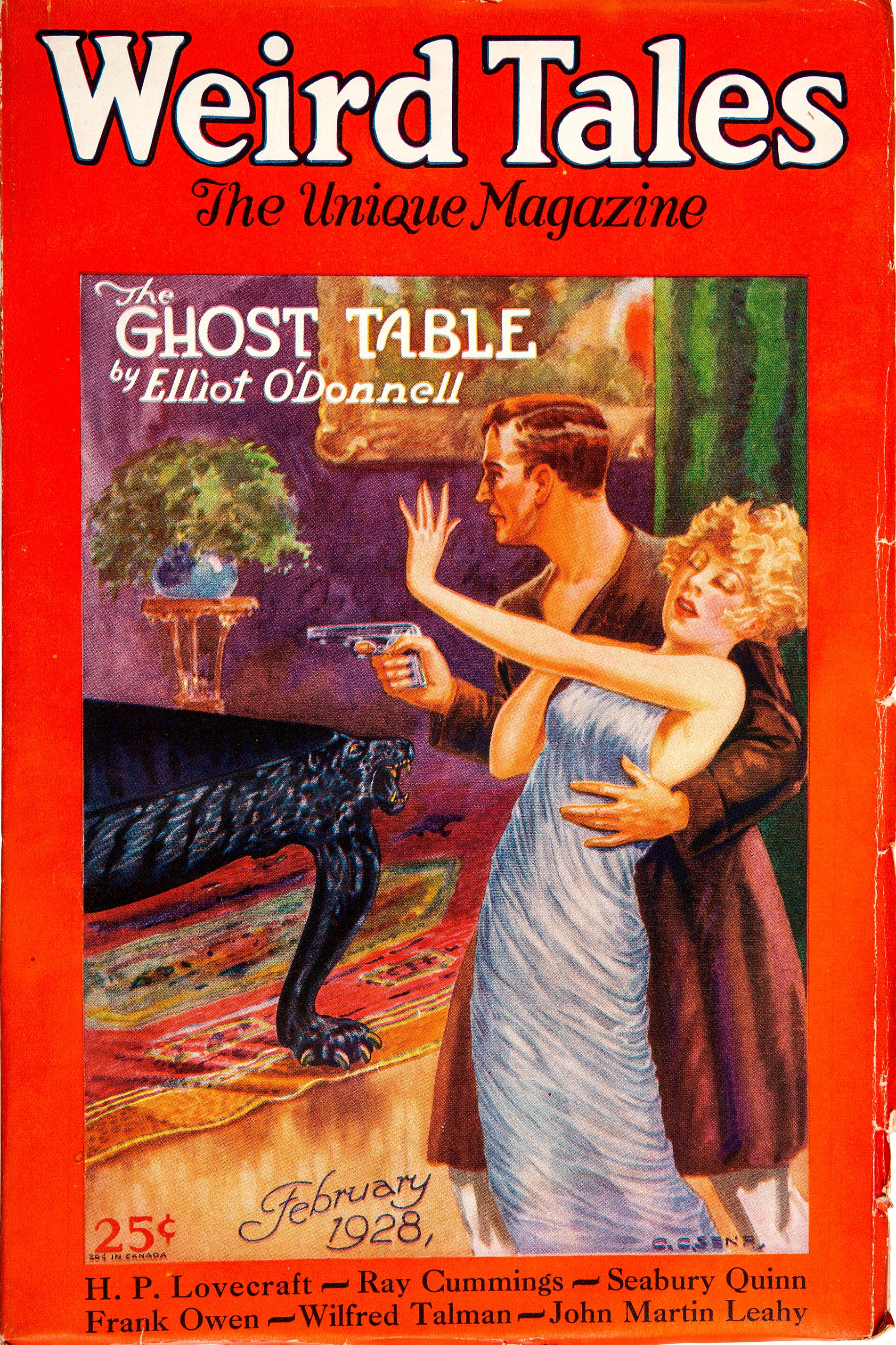
The Ghost Table? What, does it get surly when you try to dust
it? Does it smother people with Pledge?
Given that Weird Tales was Lovecraft's primary forum, maybe it shouldn't be surprising that Lovecraft once suffered from guilt by association. Similar prejudice exists today. In its prime Playboy gave attention to many neglected/soon to be famous literary luminaries. But try bringing that up in your next literary conversation and see how quickly you have to explain you're not a porn freak.
By the time Wilson got around to bashing
Lovecraft, a small and eventually famous publisher called Arkham House had
begun publishing Lovecraft in book form. Check out the very charming cover of their first Lovecraft collection. Given that Weird Tales was Lovecraft's primary forum, maybe it shouldn't be surprising that Lovecraft once suffered from guilt by association. Similar prejudice exists today. In its prime Playboy gave attention to many neglected/soon to be famous literary luminaries. But try bringing that up in your next literary conversation and see how quickly you have to explain you're not a porn freak.
But even this cover didn't totally break from the pulp tradition; it still featured exposed
nipples, which could not have been farther removed from Lovecraft’s output (or
personal life). Oh well, nipples have been closing transactions since the
first caveman opted for a Paleolithic Slugger rather than wait for last call, so I
can hardly knock Arkham House for going with what works.
I bet when Edmund Wilson weighed in on Lovecraft, he thought he was putting the subject to rest. I bet he thought his sturdy reputation and the reputation of The New Yorker would be more than enough to halt the rise of the Lovecraft "cult" (his word). It didn't work out that way. Today mighty Cthulhu lives and no one but a few dorks care about Mr. Wilson.
Still, maybe Lovecraft is indebted to Wilson. Maybe the mere fact that a major literary critic stooped to bash Lovecraft helped lift his name from the bowels of the pulp world and into more polite company. Maybe Lovecraft fans should be hailing Wilson's contribution to the astonishing posterity that Lovecraft's work now enjoys. Maybe there really is no such thing as bad publicity. It certainly can't be worse than playing second fiddle to "The Ghost Table".
Still, maybe Lovecraft is indebted to Wilson. Maybe the mere fact that a major literary critic stooped to bash Lovecraft helped lift his name from the bowels of the pulp world and into more polite company. Maybe Lovecraft fans should be hailing Wilson's contribution to the astonishing posterity that Lovecraft's work now enjoys. Maybe there really is no such thing as bad publicity. It certainly can't be worse than playing second fiddle to "The Ghost Table".
Saturday, September 29, 2012
Please mistress, may I have another Victorian novel?
You know a woman is going to be a bad date when she says, “I
read a lot of literary fiction, so I’ve earned the right to read Hunger Games!” You know that remark is
going to Part One of a biblical flood of babble, and that you’re going to have
to roofie yourself just to deal with the pain.
But enough about my life…
About “literary fiction:” People talk about the lingering
effects of Sunday school on children, how it injects them with guilt and warps
their views on sex, pleasure, and just general happiness for years afterward. I
think these commentators are on to something, and that similar guilt hangovers
are spawned in regular classrooms; especially when it comes to recreational reading.
I continue to be surprised by how many adults apologize for reading
“non-literary” fiction. You ask what they read, and they sheepishly say The Girl with the Dragon Tattoo. Why
sheepish? Because they have succumbed to the shame dished out by all those
throwaway English teachers they were forced to listen to in school; teachers who
said you must read literature, not page turners! Now as adults they carry
around guilt for picking Stieg Larsson over Emily Brontë. Instead of just
reading The Girl with the Dragon Tattoo
and experiencing pleasure, they have to apologize for it or do penance by following it up with Wuthering Heights.
To carry the sex analogy further, it is like their first
contact with reading was associated with pain—homework, being forced to endure
coma tomes like Ethan Frome—and now they
can’t experience the pleasure of reading without having some pain mixed in.
They can’t read Hunger Games without
thinking of their English teacher, their literary dominatrix shaking her head
at them for committing the sin of reading something they enjoy. It runs so deep that
even when they do “indulge” in a guilty pleasure like Hunger Games, the guilt keeps them from enjoying the full
sensation. It is like reading with 3 condoms on.
We hear plenty about Sunday school survivors moping through
life with all kinds of hang-ups about pleasure. We don’t hear about the
hang-ups of adult readers. Hardened Sunday school grads struggle with things like their
enjoyment of secular music. We laugh at them for it. We don't laugh at adult readers who struggle with their enjoyment of page
turners.
I also think this need to be “literary” exists because even
for adults, your taste in music and literature never cease to be pissing contests. Some folks are such slaves to the classroom mentality that in lieu of a GPA, they must find
a way to put themselves on some form of honor roll.
I have not read Twilight
or Hunger Games or the Stieg Larsson
books. They might deserve all the bashing they get. But as I have posted
before, I don’t believe in giving yourself homework. Reading, like anything
else, is entertainment.
Speaking of entertaininment, isn't it odd that people don’t apologize for playing
fantasy football or online poker; activities that are usually considered
frivolous, but they do apologize for being caught with a copy of Hunger Games, even though reading it means they’re
reading; an activity most people
consider innately valuable?
You want some literary fiction with your reading? You need some
pain? Next time you’re reading Hunger Games, take your free hand and smash your
fingers in a leather-bound copy of War
and Peace.
Saturday, September 22, 2012
How to judge a comedy book by its cover
I just finished John Kennedy Toole’s A Confederacy of Dunces.
After hearing about this must read comic
novel for years, I finally broke down and read it. It was okay. There are some
laughs in the last 50 pages, which is a little light for a 400-page comic novel.
So contrary to what I had heard and read, it was not the funniest thing of all
time (I wonder if the dramatic story of its publication helped inflate its reputation).
But I can be forgiven for thinking it is the greatest comic
novel ever. Just listen to some of the critical accolades printed on the cover:
Washington Post: “A
corker, an epic comedy, a rumbling, roaring avalanche of a book.”
New York Times: “nothing
less than a grand comic fugue.”
New York: “An
astonishingly original and assured comic spree.”
Here’s how you know the book is not that funny; when every
single glowing review is written in the least funny way possible. People who
know funny never say things like “grand comic fugue” or “assured comic spree.”
Imagine you heard someone talk like this in real life:
“Hey, you know who you should invite to the party? Dave. Yeah,
Dave. Why? Because he is a grand comic fugue.”
or
“Look, I know the divorce was tough, but you gotta get back
out there. I’ll introduce you to my neighbor Alice. She’s an assured comic
spree.”
Any guy in his right mind would hitch a ride on the space
shuttle to avoid a date with a woman sold him to him as an assured comic spree. And no one who
knows funny would ever say “grand comic fugue.” Or corker. You know when you
say corker? When you’re making fun of someone who doesn’t know how to describe
comedy.
Now contrast those pretentious accolades with the original New York Times review of This Is Spinal
Tap; the greatest comedy of all time:
Not a single moronic line about it being a corker, an important
film that elevates our national wit, or a cherry-topped comic dessert for those
with a comedic sweet tooth. Probably because Spinal Tap is actually funny.
Not only are lines like "assured comic spree" obnoxious; they
don’t actually describe anything. AT ALL. An assured comic spree gives no useful
indication of the book’s tone or approach. It’s like calling a metal album loud.
Yeah thanks, Professor. I’ll be sure to read your book on post-colonial tinnitus
to help me figure out that Black Sabbath isn’t whispery.
Critics are frequently useless, and are nearly always
useless when it comes to writing about funny. And unfortunately, comedians and
comedy writers are always the least listened to when it comes to the topic of
comedy. For some reason Katie Couric is allowed to tell Jerry Seinfeld what
comedy means in the aftermath of 9/11. After all, what does Seinfeld know about
anything? He’s just a comedian.
Saturday, May 19, 2012
Robert Aickman
There is a very highly regarded weird fiction writer named Robert Aickman (he called his tales "strange stories"). He published 48 during his lifetime, and although many fellow writers and weird fiction aficionados rank him among the absolute best weird fiction writers of the 20th Century, his books are very hard to find. Even buying them online means prices starting at $100.
I have seen Aickman referenced time and time again, but figured I'd probably never read him.
Then it hit me...might the New York Public Library possess a few copies?
Sure enough, they have some of his books available to read on the premises.
So I went...
The first book I requested...had been mysteriously moved off the premises. How appropriate.
The second one...was there.
As soon as I started reading his tale "The School Friend", I knew I'd found a man who was absolutely his own writer; a writer in the same league as Poe or Lovecraft. His stories are unlike most weird or supernatural stories. They have very little action. Instead, their effect is more cumulative. Every sentence has some unsettling detail, like a reference to a bed that looked like the sleeper had been awakened very suddenly, which slowly taps the amygdala.
Aickman created atmosphere through meticulous, unconventional detail. It is like with each story he was building a Jenga tower little by little. Then suddenly there is a moment where things first begin to really feel wrong, where one of those Jenga pieces is yanked out. Like the moment in "Never Visit Venice" where the women says offhandedly that they're headed to where "the real danger" is. That's when the Jenga tower first loses one of its pieces.
But unlike most weird fiction, when a piece or pieces is removed from an Aickman tower, the tower doesn't collapse like you'd expect. Instead, Aickman's towers just wobble and wobble, leaving you to wonder what the hell is keeping it up...
It is refreshing when an artist lives up to the hype. If you care about this sort of thing and have access to Aickman's work, he is worth checking out.
Here is an radio adaptation of one of his most famous stories: http://archive.org/details/Nightfall-cbcRadioProgram-episodesMp3Format
It is episode 17, "Ringing the Changes".
I have seen Aickman referenced time and time again, but figured I'd probably never read him.
Then it hit me...might the New York Public Library possess a few copies?
Sure enough, they have some of his books available to read on the premises.
So I went...
The first book I requested...had been mysteriously moved off the premises. How appropriate.
The second one...was there.
As soon as I started reading his tale "The School Friend", I knew I'd found a man who was absolutely his own writer; a writer in the same league as Poe or Lovecraft. His stories are unlike most weird or supernatural stories. They have very little action. Instead, their effect is more cumulative. Every sentence has some unsettling detail, like a reference to a bed that looked like the sleeper had been awakened very suddenly, which slowly taps the amygdala.
Aickman created atmosphere through meticulous, unconventional detail. It is like with each story he was building a Jenga tower little by little. Then suddenly there is a moment where things first begin to really feel wrong, where one of those Jenga pieces is yanked out. Like the moment in "Never Visit Venice" where the women says offhandedly that they're headed to where "the real danger" is. That's when the Jenga tower first loses one of its pieces.
But unlike most weird fiction, when a piece or pieces is removed from an Aickman tower, the tower doesn't collapse like you'd expect. Instead, Aickman's towers just wobble and wobble, leaving you to wonder what the hell is keeping it up...
It is refreshing when an artist lives up to the hype. If you care about this sort of thing and have access to Aickman's work, he is worth checking out.
Here is an radio adaptation of one of his most famous stories: http://archive.org/details/Nightfall-cbcRadioProgram-episodesMp3Format
It is episode 17, "Ringing the Changes".
Tuesday, May 1, 2012
Realism Realism
Today I was reading Borges’s A Universal History of Iniquity, and had the same sensation I usually have when reading Borges; lots of great ideas for how a story might be told…used to tell stories that aren’t memorable. Despite all the acclaim, to me he is more of a fiction theoretician than an author you might quote on your tombstone (unless your tombstone is part of some truly final dissertation).
Were it not for the liberal arts racket that has sprawled across college campuses like so many pretentious vines, I wonder whether Borges would have attained the stature he attained. Would the reading public have found as much worth in his experiments?
And now that the modern college structure seems to be sinking, what will become of artists whose output resonates more in the classroom than outside it? Without the Bow-Tie Mafia at your local Student Loan Depot assigning these works, will art theoreticians lose some of their stature? Will artists who were driven to create stories rather than curiosities experience a resurgence?
And without the art theoreticians being assigned year after year to today’s budding writers, might we see an improvement in popular culture? Will we see an end to atonal poetry? Might we pick up a fiction magazine and find a tale that does more than just congratulate itself for being a story within a story within a story within a story? If so, I’m sure someone will find a way to give the credit to Steve Jobs.
Were it not for the liberal arts racket that has sprawled across college campuses like so many pretentious vines, I wonder whether Borges would have attained the stature he attained. Would the reading public have found as much worth in his experiments?
And now that the modern college structure seems to be sinking, what will become of artists whose output resonates more in the classroom than outside it? Without the Bow-Tie Mafia at your local Student Loan Depot assigning these works, will art theoreticians lose some of their stature? Will artists who were driven to create stories rather than curiosities experience a resurgence?
And without the art theoreticians being assigned year after year to today’s budding writers, might we see an improvement in popular culture? Will we see an end to atonal poetry? Might we pick up a fiction magazine and find a tale that does more than just congratulate itself for being a story within a story within a story within a story? If so, I’m sure someone will find a way to give the credit to Steve Jobs.
Sunday, October 9, 2011
Why we keep going back to dystopian futures
Today I read an article in Wired about H.G. Wells and why "we keep coming back" to his dystopian visions. Putting aside the possibility that maybe his dystopian fiction was simply more compelling than his utopian fiction, let's remember why fiction exists in the first place...
Fiction is often called escapism, as in an escape from reality. No one tries to escape a world they like. Contentment doesn't lead to fiction being written or read. And if you hate the world as it is and want to see it wrecked, it isn't hard to see why dystopian fiction would appeal to you.
But couldn't this disposition also drive you to utopian fiction? Of course. But remember, when you're miserable, you don't necessarily want to dream of a better tomorrow. Much more satisfying to see everything destroyed so you can say "I told you so!" (H.G. Wells' epitaph: "I told you so, you damned fools.") Truly miserable people don't want a utopia that is going to deliver the whole human race, morons included. Utopia isn't any fun if your enemies get to enjoy it too.
And as the article points out, the darkest philosophical elements of Wells' visions are left out of the movies. The adaptations allude to these elements in the broadest sense, if at all. So perhaps we just keep "going back" because novels like War of the Worlds (dystopian or not) have become brand names that instantly get our attention. I would bet a big swath of the War of the Worlds film audience found Independence Day similarly entertaining.
The Tweets of the Gods can be found at http://twitter.com/#!/greatMikePayne
Fiction is often called escapism, as in an escape from reality. No one tries to escape a world they like. Contentment doesn't lead to fiction being written or read. And if you hate the world as it is and want to see it wrecked, it isn't hard to see why dystopian fiction would appeal to you.
But couldn't this disposition also drive you to utopian fiction? Of course. But remember, when you're miserable, you don't necessarily want to dream of a better tomorrow. Much more satisfying to see everything destroyed so you can say "I told you so!" (H.G. Wells' epitaph: "I told you so, you damned fools.") Truly miserable people don't want a utopia that is going to deliver the whole human race, morons included. Utopia isn't any fun if your enemies get to enjoy it too.
And as the article points out, the darkest philosophical elements of Wells' visions are left out of the movies. The adaptations allude to these elements in the broadest sense, if at all. So perhaps we just keep "going back" because novels like War of the Worlds (dystopian or not) have become brand names that instantly get our attention. I would bet a big swath of the War of the Worlds film audience found Independence Day similarly entertaining.
The Tweets of the Gods can be found at http://twitter.com/#!/greatMikePayne
Subscribe to:
Posts (Atom)