Sunday, October 14, 2012

H.P. Lovecraft's Early Days in the Afterlife

"From even the greatest of horrors irony is seldom absent."

--H.P. Lovecraft

Edmund Wilson, esteemed literary critic of the first half of the 20th Century, famously did the first serious critical review of horror writer H.P. Lovecraft. Titled “Tales of the Marvellous and the Ridiculous”, Wilson’s essay was published in The New Yorker in 1945 (Lovecraft died in 1937). The piece was scathing*, saying "the only real horror in most of these fictions is the horror of bad taste and bad art." He then went on to reduce Cthulhu, Lovecraft’s most famous monster, to “a giant whispering octopus.”**

Had Wilson been able to put aside his prejudices against pulp writing, he might have noticed that Lovecraft was probably among America’s first consistent and skillful existentialist writers.
But as unflattering as this all was to the great Lovecraft, in many ways Lovecraft was fortunate to have received this flogging. Edmund Wilson was very highly regarded at the time, and this thrashing took place in the The New Yorker of all places. These two facts are quite remarkable when you consider just what an unloved writer Lovecraft had been.
When Lovecraft died in 1937, his works had never made it into bookstores as a collection. Despite publishing the vast majority of his stories in Weird Tales, his home magazine never made any of his tales a cover story. In fact, in October 1937, just seven months after his death, Weird Tales performed a coup; a posthumous publication of Lovecraft’s The Shunned House, its first proper appearance in print. Alongside the story, Weird Tales included this bursting praise:
Howard Phillips Lovecraft died last March, at the height of his career. Though only forty-six years of age, he had built up an international reputation by the artistry and impeccable literary craftsmanship of his weird tales; and he was regarded on both sides of the Atlantic as probably the greatest contemporary master of weird fiction.
Despite calling him “probably the greatest contemporary master of weird fiction,” and despite the commercial potential of playing up this previously unpublished story, THEY STILL DIDN’T MAKE IT THE COVER STORY. Instead, the readers of October 1937 were treated to something called “Tiger Cat”.
To be fair, I have not read “Tiger Cat.” Maybe it would have increased my fear of both tigers and cats. Regardless, I find it shocking that Lovecraft couldn’t even secure a cover when it would have made the most commercial sense. Who doesn’t want to exploit a newly dead guy to increase sales, especially in 1937, with the country still in the Depression???
I cannot entirely blame Wilson, a man accustomed to poring over proper publications, for not approaching Lovecraft seriously when even Lovecraft’s home publication didn’t seem willing to set him apart. And while pulp fans may have nostalgic affection for Weird Tales, sentimentality aside, many of its stories and covers*** were unintentionally hilarious.
Case in point: I mentioned Wilson’s bashing of Cthulhu. When "The Call of Cthulhu" was first published in 1928, this landmark in horror writing did not make it on the cover of Weird Tales. Instead, readers of 1928 were treated to the horrors of “The Ghost Table”:
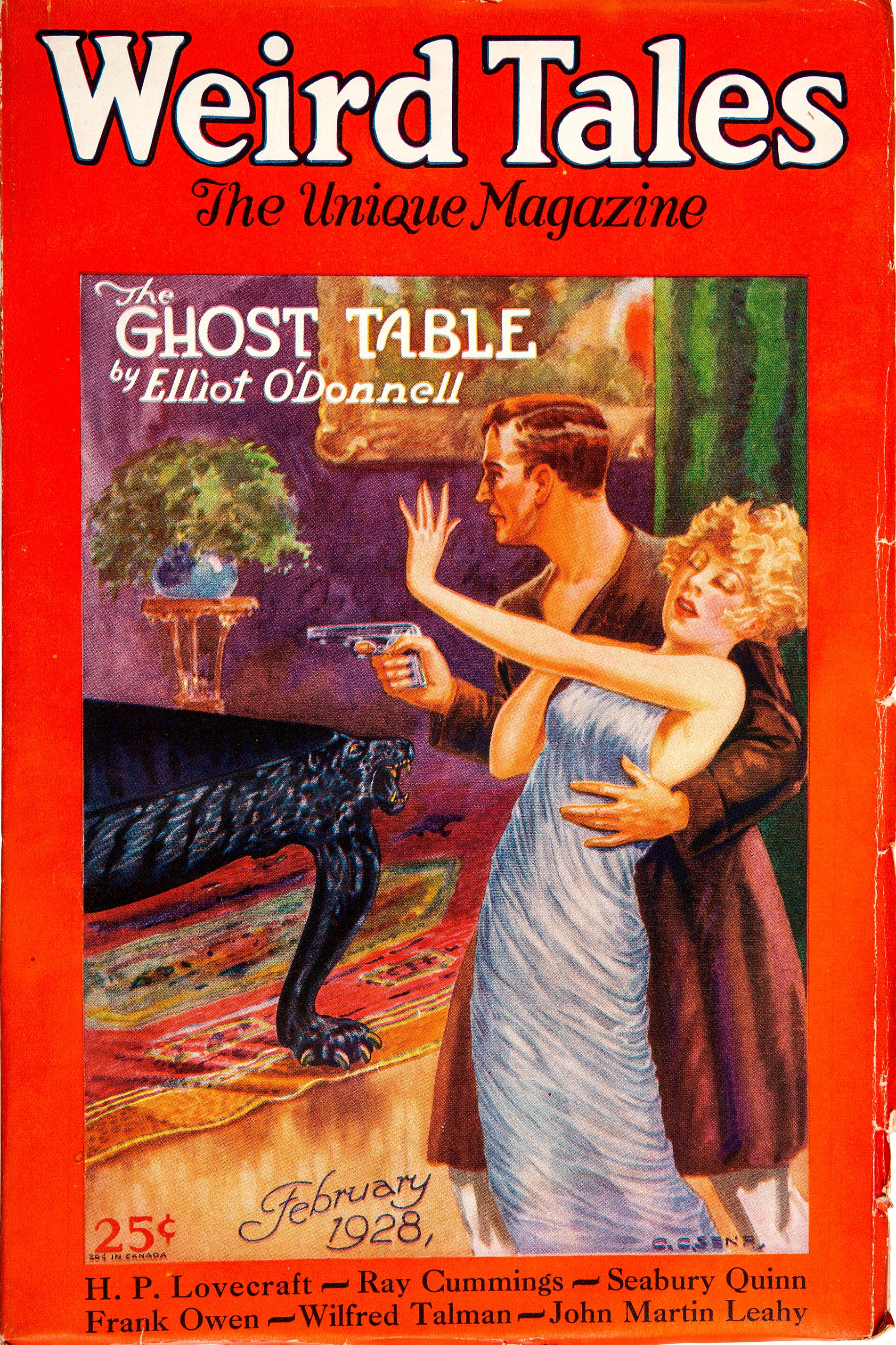
 
The Ghost Table? What, does it get surly when you try to dust it? Does it smother people with Pledge?

Given that Weird Tales was Lovecraft's primary forum, maybe it shouldn't be surprising that Lovecraft once suffered from guilt by association. Similar prejudice exists today. In its prime Playboy gave attention to many neglected/soon to be famous literary luminaries. But try bringing that up in your next literary conversation and see how quickly you have to explain you're not a porn freak.
By the time Wilson got around to bashing Lovecraft, a small and eventually famous publisher called Arkham House had begun publishing Lovecraft in book form. Check out the very charming cover of their first Lovecraft collection.  

But even this cover didn't totally break from the pulp tradition; it still featured exposed nipples, which could not have been farther removed from Lovecraft’s output (or personal life). Oh well, nipples have been closing transactions since the first caveman opted for a Paleolithic Slugger rather than wait for last call, so I can hardly knock Arkham House for going with what works.
 
I bet when Edmund Wilson weighed in on Lovecraft, he thought he was putting the subject to rest. I bet he thought his sturdy reputation and the reputation of The New Yorker would be more than enough to halt the rise of the Lovecraft "cult" (his word). It didn't work out that way. Today mighty Cthulhu lives and no one but a few dorks care about Mr. Wilson.

Still, maybe Lovecraft is indebted to Wilson. Maybe the mere fact that a major literary critic stooped to bash Lovecraft helped lift his name from the bowels of the pulp world and into more polite company. Maybe Lovecraft fans should be hailing Wilson's contribution to the astonishing posterity that Lovecraft's work now enjoys. Maybe there really is no such thing as bad publicity. It certainly can't be worse than playing second fiddle to "The Ghost Table".
 
*I don't agree with Wilson's assessment of Lovecraft, but at least the essay is well written and amusing. More importantly, unlike nearly all reviews I read today, IT ACTUALLY PROVIDES YOU WITH A CLEAR IMPRESSION OF LOVECRAFT'S STYLE AND SUBJECTS. Isn't that what reviews are for? Wilson at least cared enough to delve into the particulars of Lovecraft's approach, and he had a point about some of Lovecraft's excesses.

**Lovecraft was in good company. In 1947 Wilson wrote of Kafka: "I find it impossible to take him seriously as a major writer, and have never ceased to be amazed at the number of people who can."

***I have a soft spot for many of these covers, but prolonged exposure to them is worse for the IQ than lead paint, something an aristocrat like Lovecraft would not have endorsed.

Saturday, October 13, 2012

Pay to play God

When you're marooned in a pointless political conversation (i.e., every political conversation), an easy way to agree to disagree is to say: "The problem with politics today is that it is all controlled by special interests." This will help you shift the conversation to more important topics, like whether or not women should be allowed to drink Old Fashioneds.

Bashing special interests is a staple of every politician on every campaign trail:

I'm going to stand up to special interests.

For too long now, there has been too much money coming from special interests.

Unlike my opponent, I'm not beholden to special interests.

Of all the red meat talking points, this one might be the filet mignon. Everyone loves it.

"Special interests" are the money people who put politicians in office; the people who do the most to hire Eric Cantor or Harry Reid for the job. The word hire is appropriate.

What happens when you, a non-politician, get hired? You are expected to perform a task, regardless of how you feel about it. Your employer pays you, so in so many words he controls what you do. To keep getting that paycheck, you will recite slogans you don't believe in, follow rules that make you retch, and associate with people who if it weren't for the shared paycheck would be your sworn enemies. Why do you do all these things that run counter to your values? Because you want to keep collecting checks. That's part of what it is to have a job; bending to other people's rules and preferences in exchange for cash.

And like a politician, you lie to get the job. You lie and embellish during the interview process to get the job. You greatly overstate your previous achievements when campaigning for yourself. Some achievements you just invent altogether. Sound familiar?

Right now some dunce is reading this and is no doubt breaking out in a cold, duncy sweat: "Screw that, I own my own business! I'm my own boss!"

Not so fast lyric from a Beyonce song. You might own your own business and sing "My Way" on karaoke night, but your customers are the boss. Let's say you have a kitchen renovation business. You might hate zinc countertops. But if all the people having their kitchen redone read an article in the New York Times telling them that zinc countertops have a centering effect on urban middle children between the ages of 25-47 months, you're either going to install zinc countertops or you're going to be on a breadline. It is that simple.

If a teacher's union or oil company pays a politician a bunch of money, they aren't doing it because they like him or care about "the greater good" (whatever that means). They're doing it to hire him to perform the tasks they want performed...votes in their favor...subsidies in their direction. Money exchange=expectation of service. No one ever gives money just because. This is true of every scenario in life, politics included. The special interest groups paid Eric Cantor to do a job and they expect him to do it. If the Grand Union of Lesbian Podiatrists gives a wad of cash to Eric Cantor and he continually votes against their interests, he is breaking the deal, and he'll be fired. GULP will do whatever it can to hire someone else. Same thing that happens to you when you disobey your boss.

That is why people go to fundraisers. That is why you give money and go to rallies with your dopey signs. You too are trying to be a "special interest." Unfortunately for you, you as a special interest aren't special enough to matter. Most of you are just mad because you're losing.

And we're not just talking about the dreaded super PACs. A huge collection of grannies sending in five dollar donations to save social security (which imposes a huge cost on younger, working age people who didn't exactly sign up for it), is also a political donor/special interest situation. Perceived voting blocs also spark whoring and duplicity.

You want politicians to be just like you? Well friend, they already are. Whoever pays them gets to tell them what to do. You tell everyone you're an independent, uncompromising maverick who marches to his own drum. Then the manager at the restaurant where you work schedules you to wait tables on Super Bowl Sunday. No Super Bowl party for your independent ass. You're going to be the help at someone else's party that day. Because he said so.

I'm glad I brought up the Super Bowl, because I know someone is going to try to counter this by saying, "Hey, I'm a taxpayer, so I pay Eric Cantor's salary!" Reminds me of the sports fan who thinks he controls Mark Sanchez. Yes, in a roundabout way, you pay Mark Sanchez's salary, but Woody Johnson, the Jets owner, is the one who pays Mark Sanchez directly and handsomely. Sorry Jim The Twice a Decade Jets Game Attendee, but Mark Sanchez is going to defer to Mr. Johnson over you, and Eric Cantor is going to do the same with the folks that pay him the most. And unless a lot of Jim The Twice a Decade Jets Game Attendees rise up and do something big (rather than just complain on sports radio), it is going to stay that way.

It shouldn't take a wonk to realize that he who pays the piper the most picks the tune. Actually, most wonks seem to understand this even less than regular people. Same goes for political junkies who love to tell everyone how "aware" they are. Remove the jargon and tell them plainly that a politician accepts a check and behaves like any other hired gun and their face becomes as empty as the prospects for changing the political system.

I don't blame politicians for any of this. I blame voters for expecting it to be any other way.

Tuesday, October 9, 2012

Fall Down and Be Counted

Vince Vaughn's performance in Swingers is one of the most impressive comedic performances ever. And while people often mention how funny his character Trent is (and it is well written), it is never ranked among the great comedic performances. I think this is because Vaughn's character is confident. A winner.

Instead, when opinion makers (who have a knack for not getting comedy) make their lists of the greatest comedic performances of all time, they typically praise performances that are either nerdy/wimpy, self-deprecating, hapless, or dumb. They dote on the lovable losers and ignore the cool guys.
Some of the performances they celebrate:
Nerdy/wimpy like Dustin Hoffman in The Graduate, nerdy, wimpy, and self-deprecating like Jack Lemmon in The Apartment or Woody Allen in, well, every movie he has ever been in. They also celebrate hapless, like Chaplin as The Tramp and dumb, like Belushi in Animal House.
Why is this? Let's first think about the term comic relief. The second class nature afforded to comedic characters is evident in the term itself. He is a relief from anything substantive or real. He isn't fully realized. He is the clown intermission while we wait for the more important events to resume.
And to provide comic relief to the majority of viewers, comic relief characters must be something they can laugh AT. And because the majority of folks are nerdy, wimpy, and dumb, comic relief characters must be hyper-nerdy, hyper-wimpy, and hyper-dumb. The comic relief character must be sliding on a banana peel as he takes a banana cream pie in the face (not sure why it has to be banana cream, but a plantain pie just wouldn't be as funny).
Comic relief characters might be better known as comic reassurance characters, as they reassure the majority--the mob--that there are people who are less than they. They are smarter than Belushi in Animal House and cooler than C.C. Baxter in The Apartment. Very reassuring. They are not better than Trent in Swingers. And the opinion makers who rank such performances aren't even cool enough to have a friend like Trent (hence the snub).
The emphasis on the lovable loser ties in with the annoying truism that "good comedy must be vulnerable." Not true. Vaughn in Swingers isn't vulnerable at all. He is cool, sharp, and hilarious, which helps him to carry the film (much like Cary Grant in His Girl Friday, another underrated performance). But apparently Trent isn't "vulnerable" enough to convince opinion makers that Vaughn's is a great performance. To opinion makers, you're not vulnerable unless your character is a perennial victim...though said victim will still somehow get the girl in the end, because we can't have movies telling the truth that women don't find losers lovable.


Saturday, October 6, 2012

Workers of the world stay home

In 1994, with the help of America Online, my mother started telecommuting to work a few times a week. This was almost twenty years ago. The future was here!

I remember being 15 and thinking; “Too bad. Offices are about to become obsolete. All those commercial strip malls designed to serve commuters; the ones with poorly named delis and over-priced shoeshines…they’re about to disappear. How sad.”
(Why a teenager would be wistful about the death of watercooler chats and crap cafes that close at two might say something about the kind of daydreaming chump I was already becoming...)
I thought by now the whole concept of driving to work five days a week would be an artifact. I figured by now everyone would be driving to the office maybe once or twice a week and working from home the rest of the time. Well almost twenty years later most people still commute. Five days a week. Significant distances. To unnecessary office buildings.
We’ve gone to incredible lengths to make the car ride more fun; satellite radio, DVD players on the backs of the seats. But the fact of the car ride, the commute, remains the same.
Now in California (home of commuter dungeons like Los Angeles) they have legalized driverless cars. That’s right. They are getting rid of the inconvenience of the human hand on the steering wheel, but not the inconvenience of the human driving to work five days a week. We would rather create virtual chauffeurs than abandon the tradition of commuting to central offices.
It's not like commuting is cheap. Gas prices have gone up a lot since 1994. The price of oil has really dominated the headlines for the past seven years. And this had barely made a dent in the standard commuting routine.
 
And back when everyone was talking about climate change, what hogged the discussion? Green energy, clean energy. Not WORKING FROM HOME so you’re not constantly driving.

The focus on climate change sparked plenty of discussion about public transportation, but very little talk of not needing as much transportation. In 2012 does the subway still need be like a turkey farm each morning?
What else has changed the landscape since '94? Outsourcing. People making sales calls from India. People performing IT tasks for American companies from centers in Bangalore. We're comfortable with having sales teams in Bangalore. We're not ready for sales team working from US living rooms.
So what is going on here? Are humans just that stupid? Well yes, but I don’t believe that is the entire explanation.
Why are we still thinking inside the box? Why are employees still idling in cubicles and gathering in conference rooms? Well, when we hear about the glories of “thinking outside the box,” the inference is that everyone benefits equally when the box is bypassed. Not true. More often than not, Managers, Directors, CEOs, bosses, whatever rubric they carry, need the box to justify their existence (or at the very least their much larger salary).
Who makes the policy on working from home? Bosses do, and bosses need conference rooms to herd people into for unnecessary meetings. Bosses need everyone in that conference room looking attentive as they go through their latest list of impossible goals and unspecific ideas on achieving those impossible goals. If this same unnecessary discussion takes place through a conference call with everyone calling in from home, one person will be making the call while watching a Hoarders marathon. Another will be painting her toes. Another will be cleaning the cat box, and still another will be closing his sleepy eyes and grunting agreement when it appears necessary. Ultimately those employees will probably be just as productive, but in this scenario, the manager’s power is diminished. On a conference call where everyone is at home, no one is staring up at the boss in search of "direction." Without that hierarchical structure, the fact that he and his bosses get paid much more for contributing far less becomes easier to see (and prove). So allowing folks to work from home represents serious career risk for these diddling parasites. When people cease to be bamboozled by empty titles (and when clients stop being bamboozled by fancy offices), perhaps a major transition to large-scale telecommuting will finally take place.

One part of my 1994 prediction has come true. All over America, commercial property stands empty. In some parts of the country, LOTS of it stands empty. Not because of telecommuting; but because the economy is in such bad shape. It is enough to make you wistful.
 

Saturday, September 29, 2012

Please mistress, may I have another Victorian novel?

You know a woman is going to be a bad date when she says, “I read a lot of literary fiction, so I’ve earned the right to read Hunger Games!” You know that remark is going to Part One of a biblical flood of babble, and that you’re going to have to roofie yourself just to deal with the pain.

But enough about my life…
About “literary fiction:” People talk about the lingering effects of Sunday school on children, how it injects them with guilt and warps their views on sex, pleasure, and just general happiness for years afterward. I think these commentators are on to something, and that similar guilt hangovers are spawned in regular classrooms; especially when it comes to recreational reading.
I continue to be surprised by how many adults apologize for reading “non-literary” fiction. You ask what they read, and they sheepishly say The Girl with the Dragon Tattoo. Why sheepish? Because they have succumbed to the shame dished out by all those throwaway English teachers they were forced to listen to in school; teachers who said you must read literature, not page turners! Now as adults they carry around guilt for picking Stieg Larsson over Emily Brontë. Instead of just reading The Girl with the Dragon Tattoo and experiencing pleasure, they have to apologize for it or do penance by following it up with Wuthering Heights.
To carry the sex analogy further, it is like their first contact with reading was associated with pain—homework, being forced to endure coma tomes like Ethan Frome—and now they can’t experience the pleasure of reading without having some pain mixed in. They can’t read Hunger Games without thinking of their English teacher, their literary dominatrix shaking her head at them for committing the sin of reading something they enjoy. It runs so deep that even when they do “indulge” in a guilty pleasure like Hunger Games, the guilt keeps them from enjoying the full sensation. It is like reading with 3 condoms on.
We hear plenty about Sunday school survivors moping through life with all kinds of hang-ups about pleasure. We don’t hear about the hang-ups of adult readers. Hardened Sunday school grads struggle with things like their enjoyment of secular music. We laugh at them for it. We don't laugh at adult readers who struggle with their enjoyment of page turners.
I also think this need to be “literary” exists because even for adults, your taste in music and literature never cease to be pissing contests. Some folks are such slaves to the classroom mentality that in lieu of a GPA, they must find a way to put themselves on some form of honor roll.
I have not read Twilight or Hunger Games or the Stieg Larsson books. They might deserve all the bashing they get. But as I have posted before, I don’t believe in giving yourself homework. Reading, like anything else, is entertainment.
Speaking of entertaininment, isn't it odd that people don’t apologize for playing fantasy football or online poker; activities that are usually considered frivolous, but they do apologize for being caught with a copy of Hunger Games, even though reading it means they’re reading; an activity most people consider innately valuable?
You want some literary fiction with your reading? You need some pain? Next time you’re reading Hunger Games, take your free hand and smash your fingers in a leather-bound copy of War and Peace.

Sunday, September 23, 2012

Pina Coladas and getting caught in the rain


As we enter fall, where the days have less light and the weather slowly worsens, I am constantly on guard for morons (usually women) trying to tell me that they love the rain. That rain is romantic. That they love walking in it. That they love staying inside on rainy days (as if you couldn’t stay inside on a sunny day). Well this year, I’m not going to be a victim…
Rain as romance is a gimmick planted in people’s minds by romantic comedies, fake hipster curmudgeons, and “What Women Want” lists. Rain isn't the least bit romantic. I used to live in London, famous for its drizzle and fog, and I can tell you that after a few months of being pelted by rain the only thing I wanted to smooch was an exhaust pipe.

No one feels better in the rain. Not only is it a psychological downer; it afflicts you physically. That knee you twisted in pee-wee football? It’s fine in the summer. But let it start to pour a little: suddenly you’re limping and hating your dad for assuming that every fat kid is a born right tackle.
Doctors do not prescribe wet, gloomy climates for any ailment.

Depressed? Prescription: sunshine.
Arthritis? Prescription: sunshine.
Respiratory problems? Prescription: sunshine.
And winter isn’t much better. Sleet and cold are only sexy in the song "Baby, It's Cold Outside" (the most lascivious song ever). In real life, cold and sleet is a formula for a night alone watching deadening Internet porn.
People have to invent “romantic” activities—sitting by the fireplace, etc.—to help them cope with the horrible effects of rain. Sunshine on the other hand is romantic in and of itself.  Hot, sunny weather means less clothing, which is a thousand times more romantic than the most form-fitting raincoat. It is amazing that soggy deathtraps like London and Seattle have sold the world on this notion of drizzly romance. I should get the head of Seattle tourism to revamp my Internet dating profile.
If women are allowed to say rain is romantic, men should be allowed to say that gangbangs are romantic. At least gangbangs encourage human interaction. Rain causes people to burrow away like anti-social rodents.

And if you do get "caught in the rain," that apparently romantic event, the first thing you do is DRY OFF. No one gets soaked and says, "Well, we both look like wet dogs...time to hop in the sack!" 
Any day you have to carry an umbrella is a day you should have stayed in bed. From now on I’m only staying in hotels called The Four Summers. The only rain I want to see is the kind Travis Bickle talked about: “Someday a real rain will come and wash all this scum off the streets.”

Saturday, September 22, 2012

How to judge a comedy book by its cover

I just finished John Kennedy Toole’s A Confederacy of Dunces. After hearing about this must read comic novel for years, I finally broke down and read it. It was okay. There are some laughs in the last 50 pages, which is a little light for a 400-page comic novel. So contrary to what I had heard and read, it was not the funniest thing of all time (I wonder if the dramatic story of its publication helped inflate its reputation).

But I can be forgiven for thinking it is the greatest comic novel ever. Just listen to some of the critical accolades printed on the cover:
Washington Post: “A corker, an epic comedy, a rumbling, roaring avalanche of a book.”
New York Times: “nothing less than a grand comic fugue.”
New York: “An astonishingly original and assured comic spree.”
Here’s how you know the book is not that funny; when every single glowing review is written in the least funny way possible. People who know funny never say things like “grand comic fugue” or “assured comic spree.”
Imagine you heard someone talk like this in real life:
“Hey, you know who you should invite to the party? Dave. Yeah, Dave. Why? Because he is a grand comic fugue.”
or
“Look, I know the divorce was tough, but you gotta get back out there. I’ll introduce you to my neighbor Alice. She’s an assured comic spree.”
Any guy in his right mind would hitch a ride on the space shuttle to avoid a date with a woman sold him to him as an assured comic spree. And no one who knows funny would ever say “grand comic fugue.” Or corker. You know when you say corker? When you’re making fun of someone who doesn’t know how to describe comedy.
Now contrast those pretentious accolades with the original New York Times review of This Is Spinal Tap; the greatest comedy of all time:
Not a single moronic line about it being a corker, an important film that elevates our national wit, or a cherry-topped comic dessert for those with a comedic sweet tooth. Probably because Spinal Tap is actually funny.
Not only are lines like "assured comic spree" obnoxious; they don’t actually describe anything. AT ALL. An assured comic spree gives no useful indication of the book’s tone or approach. It’s like calling a metal album loud. Yeah thanks, Professor. I’ll be sure to read your book on post-colonial tinnitus to help me figure out that Black Sabbath isn’t whispery.
Critics are frequently useless, and are nearly always useless when it comes to writing about funny. And unfortunately, comedians and comedy writers are always the least listened to when it comes to the topic of comedy. For some reason Katie Couric is allowed to tell Jerry Seinfeld what comedy means in the aftermath of 9/11. After all, what does Seinfeld know about anything? He’s just a comedian.